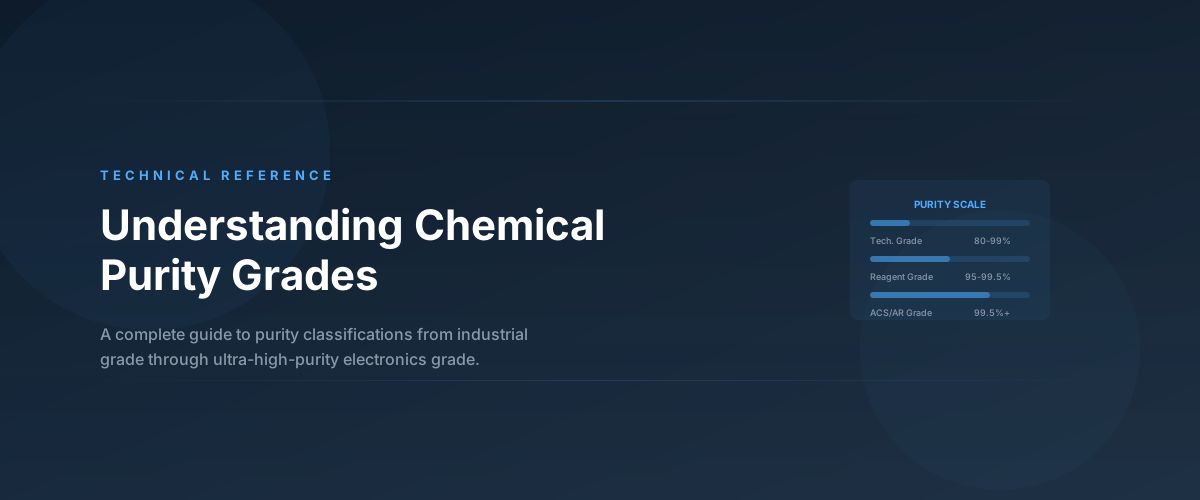
When sourcing chemicals for industrial, laboratory, or pharmaceutical applications, understanding purity grades is essential. The grade you select directly impacts product performance, regulatory compliance, cost, and safety. Choosing a grade that is too low can compromise your final product; choosing one that is unnecessarily high wastes money. This guide provides a comprehensive overview of chemical purity classifications to help you make informed procurement decisions.
Technical / Industrial Grade
Purity range: 80-99%
Typical applications: Industrial cleaning, manufacturing intermediates, agricultural chemicals, water treatment, bulk processing
Key characteristics: Technical grade chemicals are produced for commercial applications where high purity is not critical. They may contain significant impurities such as residual solvents, by-products, or trace metals. These chemicals are the most cost-effective option for non-critical applications and are typically sold in bulk quantities (drums, IBCs, tankers). At Zentish Exim, our technical grade products — including industrial acetone and sulfuric acid — meet rigorous industrial specifications while remaining competitively priced.
Laboratory / Reagent Grade
Purity range: 95-99.5%
Typical applications: Educational laboratories, general analytical work, quality control testing, research and development
Key characteristics: Reagent grade chemicals are suitable for most laboratory applications. They are manufactured to meet minimum purity standards set by organizations like the American Chemical Society (ACS). Impurity levels are controlled but not to the stringent levels required for pharmaceutical or electronics applications. These chemicals are commonly used in schools, universities, and industrial QC labs.
ACS / AR Grade (Analytical Reagent)
Purity range: 99.5%+
Typical applications: Analytical chemistry, pharmaceutical quality control, environmental testing, food safety testing
Key characteristics: ACS grade chemicals meet or exceed the purity standards published by the American Chemical Society. They have tightly controlled impurity specifications and are suitable for the most demanding analytical procedures. Each lot is tested and certified, with a Certificate of Analysis provided. These chemicals command a premium price but deliver the consistency and reliability required for regulatory-compliant testing.
HPLC Grade
Purity range: 99.9%+
Typical applications: High-Performance Liquid Chromatography, UV/Vis spectroscopy, mass spectrometry
Key characteristics: HPLC grade solvents and reagents are manufactured specifically for chromatographic analysis. They are filtered through 0.2 micron membranes to remove particulate matter, have low UV absorbance at specified wavelengths, and are free from impurities that could interfere with analytical separation. These chemicals are essential for pharmaceutical quality control, forensic analysis, and advanced research applications.
Pharmaceutical / USP Grade
Purity range: Meets USP/NF monograph specifications
Typical applications: Drug manufacturing, excipients, active pharmaceutical ingredients (APIs), medical devices, food additives
Key characteristics: USP grade chemicals comply with the United States Pharmacopeia (USP) or National Formulary (NF) standards. They are manufactured under Good Manufacturing Practices (GMP) and are suitable for use in pharmaceutical and food products. Each batch undergoes rigorous testing for identity, strength, purity, and quality. Documentation requirements are extensive, including lot-specific CoAs, stability data, and impurity profiles.
Electronics / SEMI Grade
Purity range: 99.999%+ (5N to 7N)
Typical applications: Semiconductor manufacturing, flat panel display production, photovoltaic cell fabrication, advanced electronics
Key characteristics: SEMI grade chemicals represent the highest purity category, with impurity levels measured in parts per billion (ppb) or parts per trillion (ppt). These chemicals are used in critical electronics manufacturing processes where even trace contaminants can cause device failure. They require specialized packaging (often inert-lined containers), ultra-clean filling environments (Class 10/100 clean rooms), and rigorous lot traceability.
How to Choose the Right Grade
When selecting a purity grade, consider: (1) The final application requirements — what purity does your process actually need? (2) Regulatory requirements — does your industry mandate specific grades (e.g., USP for pharmaceuticals)? (3) Cost vs. value — higher grades cost significantly more; don't over-specify. (4) Supplier reliability — ensure your supplier can consistently deliver the specified grade with proper documentation. (5) Testing and verification — do you have the capability to verify purity upon receipt?
At Zentish Exim, we supply chemicals across all purity grades, from industrial to pharmaceutical, with full documentation and traceability. Contact our team to discuss your specific purity requirements and find the optimal grade for your application.
2 Comments
A much-needed explanation for our quality assurance team. The differences between BP and USP grades are clearly explained. Thank you!
Could you write a follow-up article specifically about purity testing methods for essential oils? That would be very helpful for our industry.
Leave a Comment