Vanillin is the most widely used aroma chemical in the world. Beyond the ice cream and cake associations most people carry, vanillin is a commercially produced flavour and fragrance molecule with distinct grades, purity specifications, and a supply chain that is currently realigning around India. This guide covers what vanillin is, how natural compares with synthetic, the purity grades buyers must verify, and why Indian exporters are gaining share in global demand.
What Is Vanillin?
Vanillin (4-hydroxy-3-methoxybenzaldehyde) is the primary aromatic compound responsible for the characteristic taste and odour of vanilla. Chemically, it is a phenolic aldehyde with the molecular formula C8H8O3, CAS number 121-33-5, and EINECS number 204-183-3. Its FEMA number is 3107, which matters for food-application compliance.
Vanilla flavour in nature contains hundreds of compounds, but vanillin dominates the profile. Because natural vanilla extract is expensive and supply-constrained, the food, beverage, and personal care industries rely overwhelmingly on produced vanillin grades that are chemically identical to — or nearly identical to — the natural molecule.
Vanillin sits inside the broader category of aroma chemicals, the building blocks used across flavours, fragrances, and pharmaceutical compounding. It is a pillar product in what the industry calls the flavour and fragrance chemical complex, sharing shelf space with compounds such as coumarin, cinnamic aldehyde, and phenylethyl alcohol.
Global Vanillin Market Snapshot
Global demand for vanillin far exceeds what natural vanilla beans can supply. Industry estimates put annual vanillin demand at roughly 12,000 tonnes against only about 1,800 tonnes of natural vanilla production, which forces processors to depend on produced vanillin at scale.
Analyst forecasts for 2026 place the global vanillin market between USD 850 million and USD 950 million, with projections reaching roughly USD 1.77–1.9 billion by 2036 at a CAGR of 6.9–8.2%. Bio-based (fermentation-derived) vanillin is a smaller but rapidly growing segment, valued at around USD 221 million in 2025 and forecast to reach USD 485 million by 2036.
| Segment | Share / Figure |
|---|---|
| Synthetic vanillin share of market | 64.5% – 87.3% |
| Powder/crystal form | ~65% of volume |
| Leading application | Food (45–65% of demand) |
| Bio-vanillin market (2025) | ~USD 221M, CAGR 7.4% |
| Annual demand vs natural supply | ~12,000 vs ~1,800 tonnes |
Two structural shifts are reshaping procurement. First, the European Union has imposed definitive anti-dumping duties of 131.1% on vanillin originating in China. Second, clean-label reformulation is pushing premium food and personal care manufacturers toward natural and fermentation-derived grades. For buyers, both trends point the same direction: sourcing flexibility, documented origin, and non-China supply options. That is precisely the window Indian vanillin exporters and manufacturers are moving into.
Natural vs Synthetic vs Bio-Based Vanillin
The single most important distinction for procurement is the source and production route, because it determines allowable label claims, pricing, and compliance paperwork.
Synthetic Vanillin
Synthetic vanillin is produced mainly from guaiacol, with small volumes from lignin (a wood-processing by-product). It is chemically identical to the natural molecule, which is why food regulations treat it as nature-identical rather than artificial in many jurisdictions. Synthetic vanillin dominates industrial applications because it offers predictable pricing, reliable supply, and compatibility with high-volume processing. At roughly USD 10–15 per kg, it is the workhorse of bakery, confectionery, dairy, and beverage manufacturing.
Bio-Based (Fermentation) Vanillin
Bio-vanillin is produced by microbial fermentation using ferulic acid (typically derived from rice bran) as the feedstock. It is registered under the codex principle that allows a "natural flavouring" label under EC flavour regulations because it originates from natural precursors through a biotechnological route approved for food use. Bio-vanillin commands a premium — frequently USD 650–700 per kg or more — and is bought mainly by clean-label food brands, premium confectionery, and cosmetic houses that want a defensible natural claim.
Natural Vanilla Extract
Native vanilla bean extract is the most expensive route and is used where the full, complex vanilla profile is required. It is not the focus of commodity vanillin trade but remains relevant for premium positioning.
For a detailed framework on how "natural", "nature-identical", and "synthetic" labels are treated in flavour and fragrance regulatory practice, see our analysis of regulatory compliance for aroma chemicals and the distinctions raised in aroma chemicals in flavour and fragrance.
Vanillin Purity Grades and Specifications
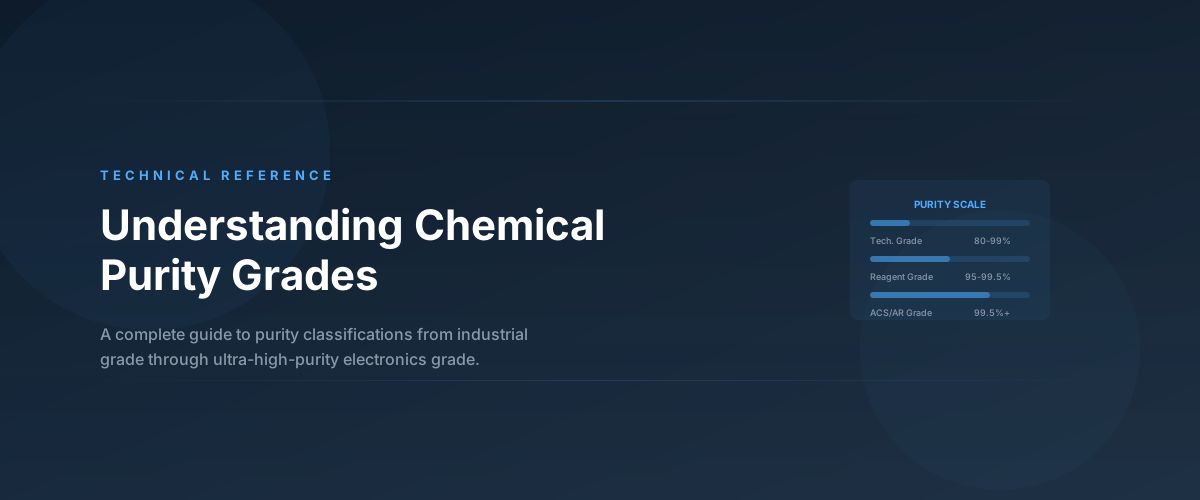
Vanillin is traded in defined purity grades, and the specification sheet is where serious buyers separate suppliers. The minimum commercial grade is typically FCC or USP requiring a vanillin assay of at least 99.0%. Higher-purity and nature-grade material is verified by GC analysis for the vanillin peak and for impurities such as p-hydroxybenzoic acid, guaiacol, and water content.
Key specification fields on a vanillin certificate of analysis include:
- Assay (GC): 99.0% min for FCC/USP grade; 99.5% min for premium grades.
- Melting point: 81–83°C for high-purity crystal vanillin.
- Water (KF): typically 0.5% max.
- Appearance: white to slightly yellow crystalline powder or needle crystals.
- Odour: characteristic vanilla — sweet, creamy, aromatic.
- Solubility: soluble in ethanol, ether, chloroform; soluble 1g in 100mL water at 25°C.
- Heavy metals: as per FCC/USP limits.
- Residue on ignition: typically 0.05% max.
If specification sheets are new territory, the practical walkthrough in understanding chemical purity grades explains how IP, BP, USP, and FCC standards relate to one another, and our guide on quality control for imported chemicals covers the analytical verification workflow.
Key Applications of Vanillin
Vanillin's application base is broad, which is why it generates such consistent global demand.
Food and Beverage
Food is the largest application segment. Vanillin appears in bakery goods, confectionery, chocolate, ice cream, flavoured milk, protein and sports drinks, and reduced-sugar formulations where it balances sweetness and masks off-notes. It also functions as a flavour stabiliser across industrial manufacturing formats. The food & beverage application landscape is covered in-depth in aroma chemicals in food and beverage.
Fragrance and Personal Care
Vanillin is used as a base note in perfumes, soaps, detergents, candles, and cosmetics. Its sweet, creamy warmth blends and rounds aggressive notes. It appears in over 8,000 fragrance and cosmetic SKUs globally. For formulation and IFRA considerations relevant to these uses, reference aroma chemicals in flavour and fragrance.
Pharmaceuticals
Vanillin is widely employed as a taste-masking and flavouring agent in pharmaceutical formulations — roughly half of oral formulations use vanillin for flavour masking. It also serves as a chemical intermediate in synthesis. Buyers in this segment typically require USP-grade documentation and stricter impurity limits, consistent with the standards discussed for the pharmaceuticals industry.
Why India Is Gaining Share in Vanillin Supply
India's rise in vanillin trade is driven by four factors:
- EU anti-dumping duties: the 131.1% duty on Chinese vanillin pushes European and UK buyers toward alternative origins, and Indian suppliers are the most established non-China source.
- Established flavour & fragrance ecosystem: India already hosts major manufacturers of allied aroma chemicals such as benzyl acetate, benzyl benzoate, and eugenol, with mature export documentation and logistics.
- Cost competitiveness: Indian guaiacol-based production is cost-competitive against global benchmarks while offering better proximity to EU and Middle East buyers than East Asian supply.
- Documentation maturity: Indian exporters routinely ship with COA, phytosanitary and origin documentation. The end-to-end paperwork is explained in our chemical export documentation guide for India.
This is a commercial advantage, but buyers still need the supplier-vetting discipline described in how to choose the right chemical supplier and the logistical terms covered in chemical trade incoterms.
How to Buy Vanillin: Grades, Documentation, and Logistics
When procuring vanillin for a food, flavour, or fragrance business, treat these as the non-negotiable checklist:
- Confirm the application grade (FCC for food, USP for pharma, nature-identical or bio for clean-label claims).
- Request the certificate of analysis and verify the assay, melting point, water content, and heavy-metals fields against your spec.
- Check the origin and the production route — guaiacol, lignin, or fermentation — because this determines label claims.
- Verify allergen, non-GMO, and Halal/Kosher documentation if your target markets require it.
- Agree packaging (typically 25 kg fibre or HDPE drums) and confirm packaging standards before shipment.
- Fix the trade terms, payment, and lead time up front via the framework in our letter of credit and payment terms guide.
Zentish Exim supplies vanillin and the surrounding aroma chemicals portfolio for the flavour and fragrance industry, with export-grade documentation and flexible packaging. Contact us with your specification and target market to receive a quote based on current availability.
Frequently Asked Questions
What is vanillin used for?
Vanillin is used primarily as a flavouring in food and beverages (bakery, confectionery, dairy, ice cream, beverages), as a fragrance base note in personal care and home care products, and as a taste-masking agent in pharmaceuticals.
What is the difference between synthetic and natural vanillin?
Synthetic vanillin is produced from guaiacol or lignin and is chemically identical to the natural molecule but cannot carry a natural label in most markets. Natural vanillin is typically fermentation-derived from natural precursors such as ferulic acid and can be labelled natural under flavour regulations.
What is the CAS number for vanillin?
Vanillin (4-hydroxy-3-methoxybenzaldehyde) has CAS number 121-33-5 and EINECS number 204-183-3. Its FEMA number is 3107.
What is bio vanillin?
Bio vanillin is vanillin produced by microbial fermentation of natural substrates such as ferulic acid from rice bran. It is chemically identical to vanillin but qualifies for natural flavouring labelling in the EU, commanding a significant price premium over synthetic grades.
What is the vanillin market size?
The global vanillin market was valued at roughly USD 850–950 million in 2025 and is projected to grow to approximately USD 1.77–1.9 billion by 2036 at a CAGR of 7–8%. Bio vanillin accounts for a fast-growing premium segment of around USD 221 million.
Where can I buy vanillin from India?
Indian vanillin exporters supply FCC and USP grades with full certificate-of-analysis documentation for global buyers, with the EU anti-dumping tariff structure favouring non-China origins. Zentish Exim offers vanillin and allied aroma chemicals for export with grade confirmation before dispatch.

0 Comments
No comments yet. Be the first to share your thoughts!
Leave a Comment